
'Okay.' 'Okay.' 'Okay.' (×500): Why David Szalay's Flesh Is a Brutal Masterpiece
A Masterful Exploration of the Human Form

“Okay”.
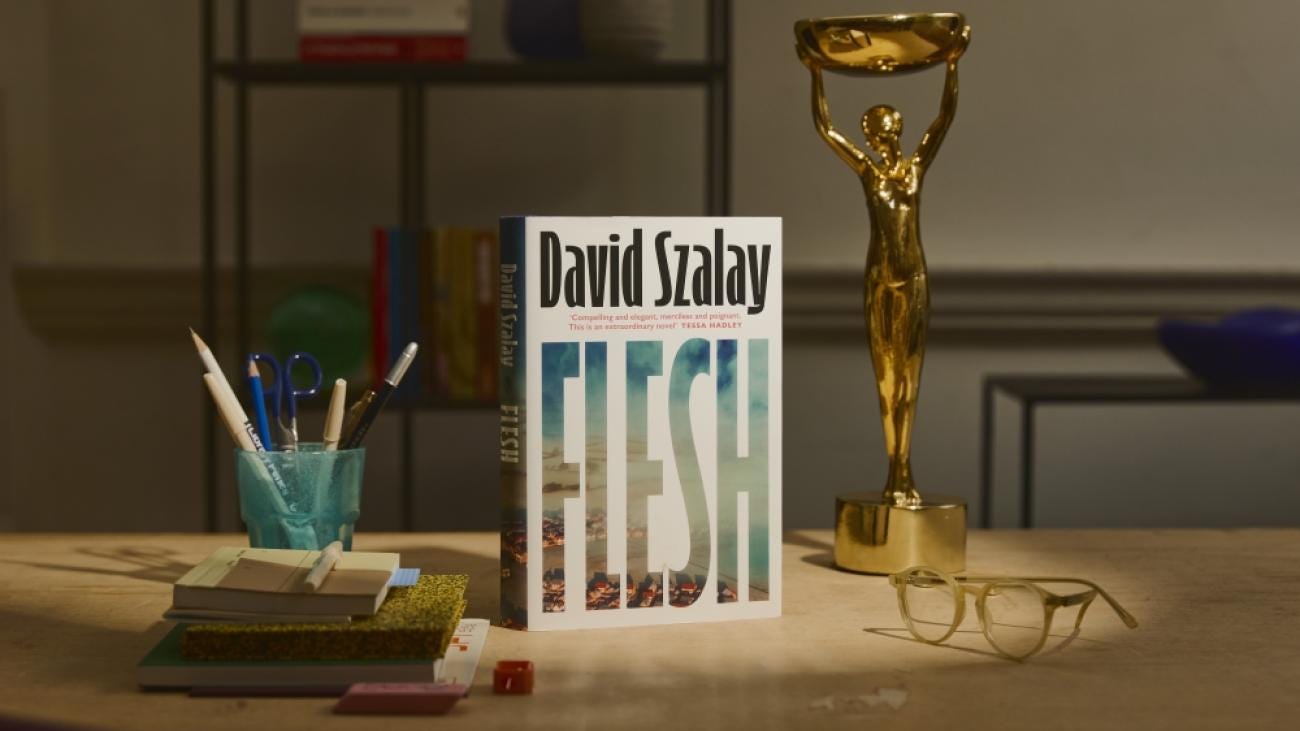
Booker Prize Winner, 2025
My rating: ⭐⭐⭐⭐⭐
This book really grew on me. It’s fair to say, I have never read a book like this. It hit me hard.
I read the first section and thought I would DNF. The word ‘Okay’ appears around 500 times in this novel. ‘Okay’. That’s about all the insight we get into István’s thoughts as he navigates a circumstantial life beyond his control. Page after page of ‘Okay.’ No elaboration. No explanation. No emotional unpacking of trauma or circumstance. Just: Okay.
I texted a friend at page 47: “I think this book hates me.”
By page 100, I understood. This book doesn’t hate me. It just refuses to lie to me.
David Szalay’s Style: Sparse, Surgical
This is my first David Szalay novel, although I am told All That Man Is features similarly sparse prose. If that’s true, I need to read everything he’s written. What Szalay does here is extraordinary in its restraint. No witty dialogues. No internal monologues. No hand-holding whatsoever.
The novel starts with a shocking episode where István, our narrator, is groomed and sexually abused by an older woman. It’s written with such matter-of-fact detachment that you almost miss the horror of it. This is, of course, exactly how trauma works. From there, István goes to a youth detention centre, fights in the Iraq War, and eventually becomes a wealthy socialite in London.
Each section of his life is rendered in the same flat, observational prose. Szalay doesn’t give you the emotional roadmap. He doesn’t tell you this moment is traumatic, this one is redemptive, this one is the turning point. He simply shows you István’s body moving through time and space, and lets you draw your own conclusions about what it means to survive.
What This Book Actually Does (And Why It Matters)
Flesh does something almost no contemporary novel dares to do: it treats the body not as a metaphor, not as a site of identity or desire or trauma (though it is all these things), but as a fact. We are meat. We are organs. We are biological processes that will fail. Szalay writes this reality with such unflinching clarity that it feels like having your skin peeled back.
There’s a moment in the Iraq section where István watches a fellow soldier die. Szalay doesn’t make this profound. He doesn’t turn it into a meditation on war or masculinity or mortality. He just describes the physical experience of being a body in danger. And somehow, that’s more devastating than any philosophical reflection could be.
Later, when István is in London, living a life of material comfort that should feel like escape, his body is still there; older now, carrying different weight, subject to different pleasures and pains. The through-line isn’t psychological. It’s biological. We follow István not through his emotional development but through his physical existence: child body, adolescent body, soldier body, aging body.
This is what Szalay means by Flesh. We are not our thoughts, our choices, our identities. We are the temporary arrangements of cells that house those things, and then we’re not. I find it fitting that Szalay came up with the title before the plot. It does seem that way.
Why the Structure Shouldn’t Work (But Does)
The novel isn’t just István’s story. It’s a series of interconnected narratives spanning different continents, different decades, different social classes. On paper, this is the kind of formal ambition that usually collapses into gimmickry. ‘Look at me, I’m writing a mosaic novel, aren’t I clever?’
But Szalay pulls it off because he understands that what connects these lives isn’t love or fate or shared experience. It’s biology. It’s the fact that all of us, eventually, become nothing but flesh. The structure mirrors the content: fragmented lives, held together only by the fact of having bodies that age, hurt, desire, and die.
Each section could theoretically stand alone. But read together, they create a cumulative effect that’s almost unbearable. You start to see the pattern. You start to recognise the inevitability. You start to understand that István’s “Okay” isn’t passive acceptance; it’s the only honest response to a life that doesn’t ask for your consent.
What This Book Won’t Give You (And Why That’s the Point)
This is not a comforting book. It will not make you feel better about being human. It won’t give you closure or catharsis or any of the things we’ve been trained to expect from fiction. There’s no redemptive arc. No moment where István “processes” his trauma and emerges whole. No satisfying confrontation with his abuser. No lesson learned.
What it will do is remind you that literary fiction, at its best, isn’t entertainment. It’s confrontation.
As an English teacher, I spend my days helping students understand how stories work. How authors manipulate emotion, build tension, create meaning. Szalay uses almost none of them. He just observes. He records. He lets the weight of accumulated detail do the work.
The Booker Got This One Right
The 2025 Booker Prize judges made the correct call. Not because Flesh is the most enjoyable book on the shortlist, or the most politically relevant, or the most beautifully written in a conventional sense. They got it right because this novel does what great literature has always done: it shows us something true that we didn’t want to see.
Who This Book Is (And Isn’t) For
I nearly gave up on this novel three times in the first fifty pages. I’m telling you this because if you pick it up, you might have the same reaction. The prose feels cold. The emotional distance feels cruel. The repetition of “Okay” feels like Szalay is trolling you.
Stay with it.
This isn’t for everyone. If you want a book that holds your hand, that guides you gently through difficult material, that ultimately reassures you about the power of human resilience: pick up anything else. There are plenty of excellent books that do that work, and they’re valuable in their own way.
But if you think you’re a serious reader, then you owe it to yourself to sit with this book’s discomfort.
Fair warning: it will stay with you. Weeks later, you’ll catch yourself looking at your own hand differently. You’ll notice your heartbeat in a way you never have before. You’ll think about the flesh you’re walking around in, and you’ll understand what Szalay was trying to tell you all along.
That’s what masterpieces do. They change your vision.
Final Thoughts
I’m still processing this book. I suspect I’ll be processing it for months. Maybe years. That’s not something I can say about most contemporary fiction, even the stuff I love.
David Szalay has written something rare: a novel that doesn’t try to make life bearable. It just shows you life as it is—brutal, arbitrary, and temporary. And somehow, in that refusal to comfort, there’s a strange kind of honesty that feels like respect.
He’s not protecting you from the truth. He’s trusting you to handle it.
Five stars. Read it slowly. Read it twice. Then sit with what it does to you.
Have you read Flesh? I’d love to hear your thoughts—especially if you disagree with me. Drop a comment below or find me on Goodreads.